
BOOK TKTS. HERE! $55.00
4.23.2013


1.29.2013
12 Bytes
Come interface at CommunalTable's
12 Bytes
in Beautiful Downtown Brooklyn
Tickets $70 (includes beverage pairings)
BUY HERE: FEASTLY
(address and directions will be provided ticket when you purchase your ticket!)
PRESENTERS:
Mihir Desai is the chief gastronomer of foodTEXT, a roving supper club which seeks to contextualise our food system through communal adventures in modernist cuisine. He consults internationally with restaurants keen to expand their experimental kitchens. Presently, Mihir is also a doctoral candidate in political economy at the Kennedy School of Government at Harvard University.
Jesse Diener-Bennett is a writer and composer writing and composing in Brooklyn, New York. Madly in love with linguistics, he often works in the space between lyrics and poetry, music and words, meaningfulness and meaninglessness. Current projects include an opera about the invention of sign language, wordmusic pieces for solo orator, and a modern retelling of Pinocchio. Notable teachers include Lewis Nielson, David Lang, and Seung-Ah Oh. Jesse is the 2012 New York Composer’s Circle composition competition winner.
Scott Draves is a pioneering software artist best known for creating the Electric Sheep, a collective intelligence consisting of 450,000 computers and people that uses mathematics and genetic algorithmsto create an infinite abstractanimation. His work shows in major museums (LACMA, MoMA.org), festivals (Prix Ars Electronica, Art Futura, Emoção Art.ficial Bienial) and is collected world-wide (CMU SCS, Simons Center for Geometry and Physics, MEIAC). His work is now
available for iPad andAndroid.
Alice Lee is a Research Chef at GNT USA, maker of all-natural colors from fruits and vegetables, and a culinary graduate of the Institute of Culinary Education in Manhattan. When it comes to creating new dishes, she is inspired by the colors, textures and flavors she has collected on her travels through Asia, Africa and Europe. She also has a degree in Food Science, and has developed many recipes for consumer products for multinational brands.
HOST: Vince Bruns is a 30 plus year fishmonger to a central Jersey community, foodie and theater addict who just happens to own a lovely condo capable of hosting 25 or 30 food fans for dinner.
11.05.2012
Jammin'
A CommunalTable Sunday afternoon of
Jam making...
 |
| Jam maker and author Elizabeth Field helped guests make jam using a recipe from her recent book Marmalade.* |
 |
| Orange and Pomegranate Marmalade boiling |
Jammy treats...
 |
| On the menu: thumbprint cookies, pb&j, guava paste and cream cheese, tomato jam with goat cheese and crackers, Nueske's** applewood ham on biscuits with green pepper jelly. cheddar and chutney tea sandwiches, and Blue Sky Bakery*** mini-muffins with apple butter |
 |
| hosts Don C. and Catherine A. getting cocktails ready: Tequila Jams on the Rocks made with blackberry shrub, lime and spiced simple syrup... served in jelly jars Jammin' |
 |
| members of the Angle Band Jam along with jammers Samuel Levine and Lucio Westmorland. Artist Emma Tapley used band members as live models for some afternoon figure drawing, |

 |
| while folks inside the house sketched still lives including oranges and pomegranates from the jam! |
** Nueske's http://www.nueskes.com/ Nueske's NE regional rep. Terri Sweetbaum kindly donated ham to CommunalTable and we were excited to share this Wisconsin company's delicious goods!
*** Blue Sky Bakery http://cheapassfood.com/eats/show/311-blue-sky-bakery Baker's Eric and Jorge brought some muffins with them to add to all the other treats!
**** and special thanks to Annabel Willis for snapping these pictures!
10.02.2012
Jammin'
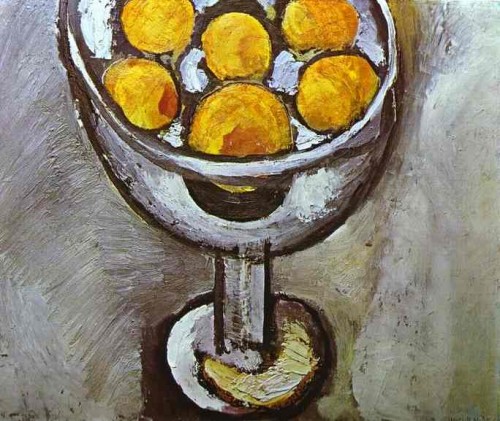
Henri Matisse, A Vase with Oranges, 1916
Oil on canvas, Private Collection
Oil on canvas, Private Collection
Hey Hey Hey... everyone should come to Mushrooms-n Moonshine and I want that to be the blog post y'all see should you land on this page... but Jammin' is coming up 10/21... so snap up the limited tkts. for that!!! (and scroll down for the info on buying tkts. for Mushroom's)
Should be able to describe Jammin' in a few snappy words- but its kinda complicated. Came about when a few artist friends were sitting 'round saying we should get together on Sunday afternoons and pitch-in and hire a live model and do some figure drawing... then one of the people we were sitting with who is a musician said- "hey- my band could come and we could be your models" and so the idea was hatched! Jammin' musicians and drawing and then, why not add jam-making too?
Come join communaltable for a Sunday afternoon of warmth, storytelling, jam-making, music, and drawing. We'll meet in a beautiful Prospect Hts. brownstone and be fortified with jammy treats, a jammy cocktail and good cheer! And you get to go home with your own jar of homemade marmalade!
Tickets are $35 and are on sale via SideTour
http://www.sidetour.com/experiences/ignite-all-five-senses-by-making-jam-and-drawing-with-music?fb_action_ids=10152165555825154&fb_action_types=og.likes&fb_source=aggregation&fb_aggregation_id=288381481237582
9.06.2012
Mushroom and Moonshine Redux Columbia County Event Sat Oct 27+ Sun Oct 28 2012
It's official! Tickets are on sale for our October event!

Come join us as we journey upstate to scenic Columbia County NY to forage fungi, then relax over cocktails as a mycologist helps identify our finds. Identification is followed by an extravagant mushroom feast. After supper we'll sip moonshine around the campfire and regale each other with fairy and ghost stories.*

 |
| photos copyright Karen Crumley Keats http://bookandtree.com/ |
(includes foraging walk, cocktails, supper, brunch and print workshop)
click below to buy tickets!

Maps and locations will be sent separately by email.
We're gathering a list of nearby campgrounds, Inns and B&B's and preparing a map of local orchards and farms you might enjoy visiting. Check back for updates.
* Fungi are one of the taxonomic kingdoms of species that enjoy life on this earth. Others include bacteria, plants, animals.... why not include fairies and ghosts too! That's what we'll be doing around our campfire. Bring your favorite story to share around the fire. We'll offer up a special toast if you can weave mushrooms into your tale!
8.09.2012
Hey!!!! We're back....

So back we are, hopefully to popular acclaim. Maybe this go-round we'll break-even producing these events- or gosh, begin to earn our keep! In these next few weeks look for posts with calendar, location, and ticket/reservation information... Please spread the word widely! We're hoping to expand our audience, and through this, find new and interesting collaborators and spaces. We are thinking of Communal Table as an "umbrella" many can fit under-- the more engaging, delicious, fun salons produced, the closer we come to realizing our mission, which is to create community with food and stories.
Till then, here's a taste of some ideas we're nurturing:
Back by popular demand: Mushrooms and Moonshine redux wherein we journey Upstate to forage fungi, then relax over cocktails as a mycologist helps identify the specimens we've found. The identification is followed by an extravagant vegetarian mushroom feast... (just found an interesting recipe for Chanterelle butter, and another for mushroom syrup.) After supper we'll build a bonfire and regale one another with fairy and ghost stories (I'm looking for tales that feature magic mushrooms!) To cap-off this event- the next morning we'll picnic on mushroom frittatas and homemade pastries on a tiny private island in Lake Kinderhook. We are gathering a list of nearby B&B's and preparing a map of local orchards and farms you might wanna visit on your way home.
Jamming An afternoon of musical jamming, fruit jam making and jammy treats. Guests are invited to sketch (we're thinking of the musicians as models and the fruit and jam-making as still-life. Art supplies will be provided, as will jars to fill with jam to take home!) Come nibble and scribble and sing-along.
12 Bytes This is a new take on our previous Sing for your Supper Musicale. We'll serve a four course meal made of three bites each, and in between each course an artist whose work is computer-based (hence bytes, ha ha!) will present a short piece for your pleasure.
The Winter Spa Drawing on the popularity of DIY we'll spend an afternoon sipping tisanes, knitting booties and home-making herbal facials and scrubs. Snack on antioxidants, probiotics and chocolate! And if you'd like, indulge in cocktails flavored with essential oils.
10.08.2011
notes from Uganda

Diesel trucks carrying men and goods
rumble down the rutted road that runs north/south
rumble down the rutted road that runs north/south
through Gulu and then to Southern Sudan.
Shocks are worn, the road is narrow, the traffic is alarming.
Listing overcrowded busses hurtle at terrifying speed in both directions.
Shocks are worn, the road is narrow, the traffic is alarming.
Listing overcrowded busses hurtle at terrifying speed in both directions.
Motor bikes weave, bicycles balance,
children hauling jerry cans of water trail goats on strings.
Pigs wallow in puddles in ditches on the side of the road,
children hauling jerry cans of water trail goats on strings.
Pigs wallow in puddles in ditches on the side of the road,
pigs, and Malaria carrying mosquitoes.
Traversing short distances takes all day.
Traversing short distances takes all day.
Red dust settles on everything.
Along this road clusters of thatched huts
house extended families. No running water, no electricity.
Along the road hawkers sell coal and cabbages.
Now and again there are Primary Schools, NGO’s, Churches,
cell phone towers and Government boreholes.
Now and again we pass trading centers,
leftover shops from the camps tha
t housed thousands
during the war that just barely ended.
Turn off this road past Atiak to find Earth Birth, a maternity center founded towards the end of the war by Rachel, daughter of a guitar playing Oregon Rabbi, and Olivia, a Jersey girl with bright red hair who practices Native American Shamanism.
during the war that just barely ended.
Turn off this road past Atiak to find Earth Birth, a maternity center founded towards the end of the war by Rachel, daughter of a guitar playing Oregon Rabbi, and Olivia, a Jersey girl with bright red hair who practices Native American Shamanism.
Let me tell you,
pregnant women walking as fast as they can looking for help,
die giving birth along this road or if they get there,
they bleed to death or die from infection in ill equipped hospitals.
Babies die faster.
Happily married women too,
The war is over, but still, girls who were sex slaves of soldiers,
or concubines to Warlords die with the children they bare.Happily married women too,
delivering five, six kids before age twenty five,
walk this same road, and many of them die too.
I have come here to Northern Uganda to celebrate the work my friends are doing,
walk this same road, and many of them die too.
I have come here to Northern Uganda to celebrate the work my friends are doing,
and to help prepare food
as they host a weeklong International Midwifery Symposium themed on Birth and War.
The place is a construction site. The new compost toilet replacing the wretched hole in the ground does not yet have its door. The mud hut I sleep in is still wet.

But the clinic’s birthing rooms are in constant use and the kitchen’s up and running.

It is Nighty’s kitchen. She cooks for the staff and day-workers
and the women who labor in the clinic.
Girls from the neighboring orphanage who study English
and Tailoring and Catering in school have come to help us cook.
We are feeding 50 Traditional Birth Attendants (TBA’s) from neighboring villages
and the women who labor in the clinic.
Girls from the neighboring orphanage who study English
and Tailoring and Catering in school have come to help us cook.
We are feeding 50 Traditional Birth Attendants (TBA’s) from neighboring villages
and 20 student midwives from around the world.
We wake to cock’s crow starting breakfast at first light.
There is good Ugandan coffee, packets of milk that requires no refrigeration,
black tea and honey.
Nighty teaches me to make the morning chapattis; fried flatbreads.
She shows me how to make the dough by handfuls and texture,
and to roll the dough with an oiled beer bottle.
I worry about serving deep fried food but realize not one person I’ve seen is overweight. Calories here mean something different than at home.
The whisk I brought is great for scrambling eggs,
which cook up white because of the chicken’
s anemic diet.
Chapatti and eggs one day, and Mandazi,
a vanilla scented doughnut served with mango jam the next.
a vanilla scented doughnut served with mango jam the next.
I have brought Nighty three cookbooks:
a children’s book full of illustrations,
and two books about African American cooking.
The recipes use similar ingredients to what’s found here
and are written with simple words.
In between breakfast and lunch we sit together and read.
Nighty is delighted. These books comprise her entire library.
Centuries ago there was the Columbian Exchange
and things have kept shifting ever since:
American corn replaced millet and sorghum
and our peanuts, peppers and tomatoes became staples.
In exchange, we got rice, collards and slaves.
Today I learned to pick white pebbles from broken rice piled on a white cloth sac,
also to winnow old beans from a heap.
The women laugh with good nature because I am so slow.
Chickens underfoot squabble mercilessly, then pick the gleanings.

The girls from St. Monica’s feed smoky fires, tend pots of beans,
recline on papyrus mats talking
and laughing, waiting for maize porridge to boil.
They carry water from the well,
and bend over buckets washing dishes on the ground.
The green scrubby I brought to wash vegetables
turns out perfect to strain passion fruit pulp for lunchtime juice.
and bend over buckets washing dishes on the ground.
The green scrubby I brought to wash vegetables
turns out perfect to strain passion fruit pulp for lunchtime juice.


Nighty walks up to the kitchen with a flat stone I cannot lift balanced on her head.
Her son Stuart is strapped to her back.
We pound dry roasted groundnuts and sim sim in a heavy mortar with a heavier pestle,
then kneel in the doorway to grind the nuts to paste on the stone.
This is blended with slow cooked greens and eaten with boiled yams.
On Olivia’s daughter Zora’s first birthday I make pudding instead of cake.
We light candles and top the pudding with flowers from the garden.
This is blended with slow cooked greens and eaten with boiled yams.
Along with rice and beans and greens,
I make frittatas and pasta and salads to keep the visitors happy.
There is no oven, only wood fire and a rickety two-burner run off propane tanks.On Olivia’s daughter Zora’s first birthday I make pudding instead of cake.
We light candles and top the pudding with flowers from the garden.
There is no fridge, no sink, no place for garbage.
We compost, feed chickens and stray dogs and burn the rest.I bask in privilege not hauling water and work hard to train myself to wash up less.
The visiting midwives eat at plastic tables under colorful umbrellas,
using forks and spoons. They speak of breech babies and placenta praevia,
and if they are lucky and the suns position lets them get online,
check emails from home.
I sit by the serving platters waving away flies and chickens,
and toddlers with dirty hands.
The TBA’s line up for bowls of maize flour porridge and beans cooked by the girls,
which they carry down towards the clinic
where sit on mats and eat with their hands.
Music wafts our way from where they eat.
I sit by the serving platters waving away flies and chickens,
and toddlers with dirty hands.
The TBA’s line up for bowls of maize flour porridge and beans cooked by the girls,
which they carry down towards the clinic
where sit on mats and eat with their hands.
Music wafts our way from where they eat.
Today we decide on meat.
Zora’s baby-daddy visiting from Kampala for her birthday
chases down El Jefe, the mean white cock.
In the service of humane slaughter I offer use of my prized Japanese knife.
The knife’s blade is not suited to cut through bone,
but using it rather than the kitchen’s dull knives seems a blessing.
Everyone laughs because I’ve never killed a chicken before
and because I’ll snap pictures but will not cut the chicken’s throat.

Killing the chicken chips the knife.
I decide I’ll leave it for Nighty.

The washtub stinks of blood. Wet feathers stick to my hands.
We sit on the floor eviscerating birds with a broken knife,
separating ours and theirs; breasts and thighs vs. head, feet, wingtips, and offal.
I flavor our broth with bay leaves and thyme brought from Brooklyn.
and Nighty uses Royco; a bullion she favors to season everything.
The pots simmer for hours. The broths are delicious. The meat is tough.
At dusk scattered chickens cluster near the warmth of the cooking fires
until Dante the new top cock calls them to roost.

Subscribe to:
Posts (Atom)